


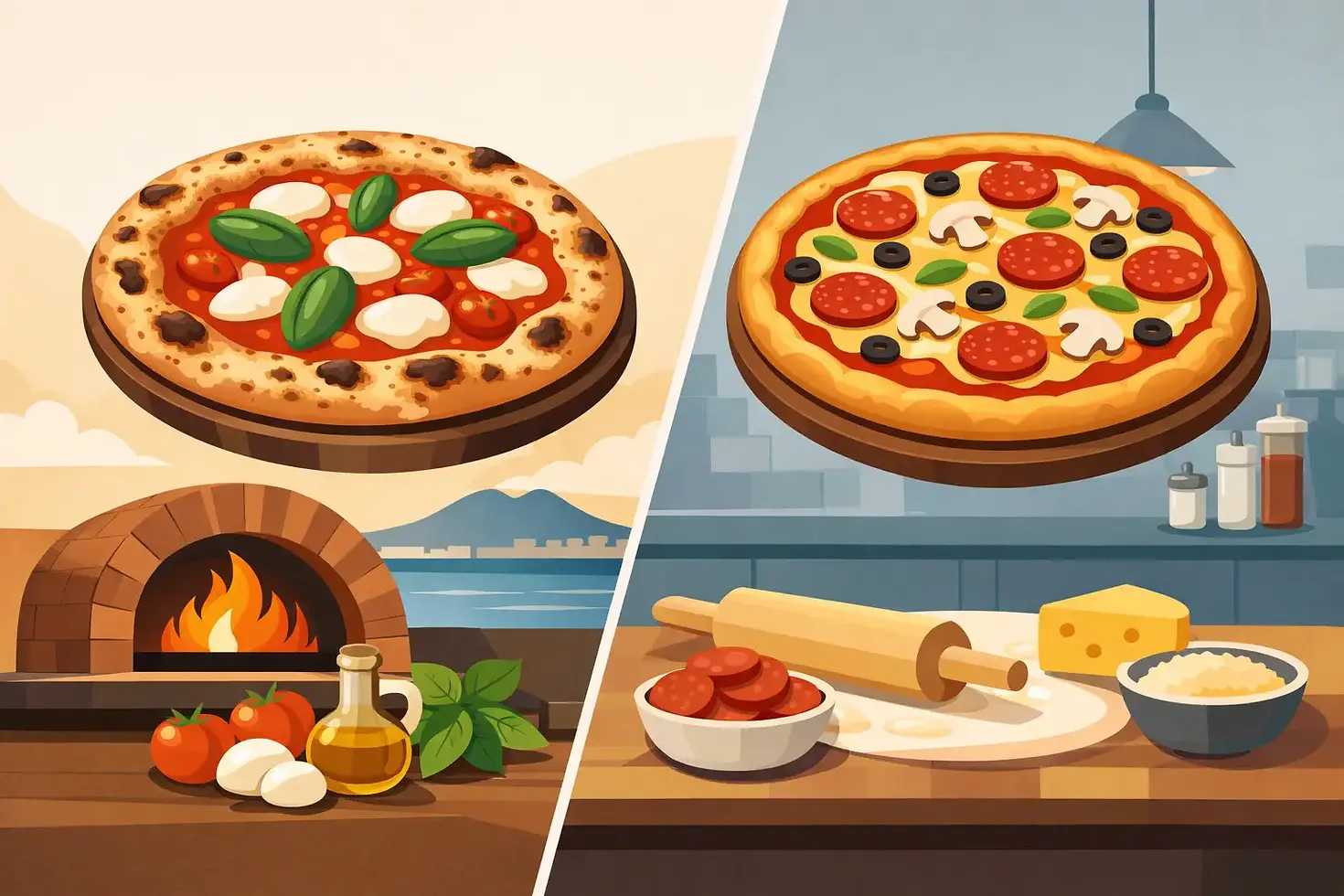
Différence pizza napolitaine et pizza classique

You can often spot it before the first bite. One pizza arrives with a soft, airy crust, leopard-spotted edges, a center that folds slightly, and a fresh tomato aroma that feels straight out of Naples. The other is usually flatter, firmer, more uniform, and built for structure first. That is the real différence pizza napolitaine et pizza classique - not just style, but a whole philosophy of dough, heat, texture, and taste.
If you love pizza but have never quite put words on why one feels more alive, more light, or simply more memorable, this is where the difference becomes clear. And if you already know you prefer the Neapolitan style, understanding why only makes that first slice better.
Différence pizza napolitaine et pizza classique : where it starts
The biggest gap begins with the dough. A pizza napolitaine is built on a simple base - flour, water, salt, and yeast - but the result depends on time, technique, and respect for the process. The dough is usually fermented long enough to develop flavor and elasticity, then shaped by hand to keep air inside the rim.
A classic pizza, especially in the broader American and European sense, can mean many things. It may use more oil, more sugar, a shorter proofing time, or mechanical rolling that presses the gas out of the dough. None of that automatically makes it bad. It just produces a different result: more even, more dense, and often more predictable.
That difference matters because dough is not just the support. It is a major part of the experience. In a true Neapolitan pizza, the crust is not an afterthought. It is tender, fragrant, and part of the pleasure from the first bite to the last.
The crust tells the story
If you put both pizzas side by side, the crust gives everything away. A pizza napolitaine has a raised edge, called the cornicione, that is light and inflated. It may look dramatic, but it should never feel dry or heavy. When done right, it is soft enough to tear easily and airy enough to hold a delicate balance between chew and melt.
A pizza classique usually has a lower, tighter rim. Sometimes it is crisp all the way through. Sometimes it is thick and bread-like. Sometimes it aims for crunch rather than softness. Again, this depends on the style, because "classic" is a wide category. But in most cases, it is less about fermentation character and more about firmness and topping support.
This is also why people sometimes misunderstand Neapolitan pizza at first glance. They see a soft center and think it is undercooked. It is not. It is meant to be supple. That flexibility is one of its signatures.
The cuisson changes everything
A pizza napolitaine lives or dies in the oven. Traditional Neapolitan pizza is baked very fast at extremely high heat, typically in a very hot pizza oven. The goal is not slow drying. It is rapid expansion, slight charring, and a dough that stays moist inside while cooking through.
That is what creates the classic contrast: blistered crust, tender interior, bright sauce, and cheese that melts without becoming greasy or overworked.
A pizza classique is often baked longer and at a lower temperature. That longer bake gives a drier crumb, a firmer base, and more uniform browning. Some people prefer that, especially if they want a crisp slice that holds perfectly in the hand. But the flavor profile shifts. You lose some of the soft, almost cloud-like texture that makes a Neapolitan pizza so distinctive.
Heat is not just a technical detail. It shapes the whole bite.
The toppings follow a different logic
One of the clearest points in the différence pizza napolitaine et pizza classique is restraint. Neapolitan pizza is not about loading as many toppings as possible. It is about balance. The tomato should taste like tomato. The mozzarella should stay milky and fresh. The basil should smell like basil. Olive oil should finish, not drown.
A classic pizza often pushes in another direction. More cheese, more sauce, more toppings, more combinations. That can be generous and comforting, and there is a place for it. But it changes the center of gravity. The pizza becomes heavier, saltier, and more topping-driven than dough-driven.
That is the real trade-off. If you want abundance and a big, packed slice, a classic pizza may satisfy that craving better. If you want clarity of flavor and a more elegant balance between crust, sauce, cheese, and heat, the Neapolitan approach stands apart.
Sauce, cheese, and ingredient quality
Neapolitan pizza depends on ingredients that do not need to hide. Because the topping layer is usually lighter, every element is easier to taste. Tomatoes bring sweetness and acidity. Fior di latte or mozzarella di bufala adds creaminess. A few leaves of basil give lift. Good olive oil rounds the whole thing out.
With a pizza classique, the ingredient strategy can be broader and more forgiving. Stronger sauces, shredded cheese blends, cured meats, vegetables, and richer combinations are common. That can create bold flavor, but it also means individual ingredients are less likely to stand on their own.
This is one reason authentic Neapolitan pizza feels so honest. There is nowhere to hide. If the dough is weak, you notice. If the tomatoes are flat, you notice. If the cheese is low quality, you notice immediately.
Texture: soft and airy versus crisp and structured
Texture is often where preferences become personal. Neapolitan pizza is soft, elastic, and light despite its visible crust. The center can be tender enough that many people eat it with a knife and fork at first, or fold it slightly before biting. That is not a flaw. That is the style.
A classic pizza usually aims for more structure. The base is often sturdier, the slice more rigid, and the overall feel more compact. For takeout or delivery over longer distances, this can be practical. A firmer pizza travels more easily and keeps its shape better.
That is an important point: authenticity and practicality are not always the same thing. A pizza napolitaine is at its absolute best when it is eaten quickly, still hot, still alive from the oven. A classic pizza can sometimes be more forgiving if the meal starts later or the box stays closed for the ride home.
Why people often say Neapolitan pizza tastes lighter
Even when it looks generous, Neapolitan pizza often feels lighter to eat. There are a few reasons. The dough is usually less loaded with fats or sugar. The toppings are more measured. The bake is fast. And the crust, because it is airy, does not sit as heavily as a dense base.
That does not mean it is always lower in calories in every case. It means the eating experience is lighter, cleaner, and less weighed down by excess cheese, excess sauce, or overbaking.
For many guests, that is the difference between feeling satisfied and feeling overfilled.
What "classic" really means
The word "classique" can be misleading because it covers a lot of ground. It might refer to a standard pizzeria pie, a pan pizza, a New York-style slice, a thick crust delivery pizza, or a more generic restaurant version inspired by several traditions at once.
So when people compare pizza napolitaine and pizza classique, they are not always comparing one strict recipe to another. They are usually comparing a protected, tradition-led style to a broader, more adapted category.
That is why Neapolitan pizza has a clearer identity. It knows exactly what it wants to be. A classic pizza can be good, but it is often defined more by habit and local preference than by a precise culinary code.
Which one is better?
It depends on what you want from the meal.
If you want a pizza with character, fermentation flavor, a soft and airy crust, fresh ingredients, and that unmistakable oven-fired finish, the Neapolitan style is hard to beat. It offers a more authentic Italian experience and a stronger connection between technique and taste.
If you want a firmer slice, heavier toppings, more crunch, or something that travels with less fragility, a classic pizza may fit the moment better. There is no need to pretend one style answers every craving.
But if the question is which style expresses a deeper pizza tradition, the answer is clear. Neapolitan pizza is not simply another version. It is a benchmark.
That is also why places that take it seriously stand out. At Mono Pizza Napolitaine, the appeal is not only the recipe. It is the feeling that the pizza arrives with intention - warm, generous, and faithful to what made Naples famous in the first place.
The next time a pizza lands on your table, look at the crust before you taste it. If it is airy, blistered, soft at the center, and built with restraint rather than excess, you are not just eating pizza. You are tasting a tradition that still knows exactly why it matters.



Commentaires